
I have a habit of memorializing July 3, 1863 — the end date of the Battle of Gettysburg. When I’m home, I will usually stream Episode Five of The Civil War by Ken Burns: The Universe of Battle. (Actually, I still own the DVD box set.) I’ve written about this habit of mine before. Indeed, I texted friends of mine “Happy July 3rd!”
I believe Gettysburg matters now more than ever because the victory there opened America to a possibility of “a new birth of freedom.” But that possibility can still be lost.
Now, I realize you’re probably reading this while celebrating Independence Day 2025. You might be thinking, isn’t “The Fourth,” which celebrates the signing of the Declaration of Independence on July 4, 1776, the holiday that matters? If July 3rd was a big deal, you might argue, it would be a holiday too. Maybe you’re lauding the fact that the Declaration pronounced that “all men are created equal.”
But that proposition, while an eloquent and seminal idea, isn’t the entire story. Thomas Jefferson, the drafter of the Declaration, wrote, then under pressure, deleted an anti-slavery passage from the Declaration. Even after the Revolution, slavery shaped the framing of the Constitution and divided the United States for decades. Indeed, Fredrick Douglass, lauded abolitionist and civil rights activist, pointed out in 1852 the meaningless of celebrating the liberty and equality proclaimed on the Fourth of July in the face of chattel slavery. All persons may have been created equal, but slavery created a caste system that divided America.
This entrenched conflict over slavery came to a head in the Civil War, and 87 after the founding, on July 1-3, 1863, the Battle of Gettysburg was fought. To quote the Smithsonian Institution’s essay celebrating the 150th anniversary of the Civil War, the Battle of Gettysburg was “the moment of decision” for the conflict.
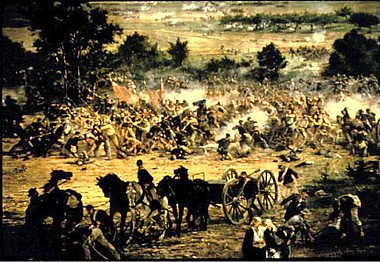
“Gettysburg changed everything,” the Smithsonian essay continues. After the defeat of the Army of Northern Virginia, “[t]he North began to see Robert E. Lee as a mortal, a flawed individual capable of being defeated. Also, coupled with General Ulysses Grant’s vanquishing of the last southern stronghold on the Mississippi—Vicksburg fell on July 4, the day after the conclusion of Gettysburg—the North believed that the Union cause had finally acquired military leaders capable of prosecuting the war.”
The possibility of new liberty through Union victory became clear in July 1863.
And with victory in April 1865 came Reconstruction, and with it the abolition of legal slavery, the redefinition of citizenship, and the creation of the foundation of the civil and political rights in America today. Yet, as quickly as these rights were articulated, these rights were betrayed through political manipulation, judicial undercutting, and open racial violence. Nearly a century of Jim Crow segregation ensued, and America needed protest from Selma to Washington to lead to a Second Reconstruction that (re-) establish the promise of formal civil and political rights for all. And even today, the terms of Reconstruction are still being debated and can be lost.
But without the conclusion of the Civil War, and the turning of the tide of that war made at Gettysburg, the United States as we know it now could never have existed. Indeed, without the victory at Gettysburg, Lincoln could not have articulated in his famous address at the dedication of the Gettysburg battlefield, a new declaration for the United States:
that this nation, under God, shall have a new birth of freedom – and that government of the people, by the people, for the people, shall not perish from the earth.
To read July 3rd along with July 4th, to see the scope of America as ranging from Independence Day to Gettysburg, from the Colfax Massacre to Selma, from the beginning to today and all the struggle in between, is to recognize that the work of Reconstruction remains incomplete.
It is to celebrate how far American has come, but to recognize how far America has to go to fulfill its promise. Propositions that we used to think of as well settled — like birthright citizenship, a universal right to vote, and a commitment to liberty and justice for all — remain contested a century and a half later.
And so long as we debate whether some have rights, and others suffer as a consequence, none of us is truly free. And the work of changing this for the better, of making us all free is, in Lincoln’s words, “the great task remaining before us.”
 First, the Court held that the power to regulate individuals and corporations fell to the states, not the federal government. Second, to the extent Congress passed the Act under its Fourteenth Amendment authority, the Court held that the Fourteenth Amendment was limited to regulating actions by states and not private actors (a doctrine that still holds today). Finally, the Court interpreted the Thirteenth Amendment, meant to remedy the badges and incidents of slavery, as only allowing Congress to abolish denials of legal rights extending from past slavery.
 At the heart of the modern battles over the American right to vote is a tension between two constitutional values. On one side is the original Constitution and the autonomy it grants the states over the franchise. On the other are the Reconstruction Amendments and the modern demands for equality. With few textual caveats, the Constitution of 1789 gave states near-autonomy to shape the right to vote. Many states did so in a way that reflected an antebellum vision of citizenship rooted in popular (in its time) eighteenth-century notions of status, wealth, and identity—a definition that excluded many. This value of autonomy, and the social ordering underlying it, continues to influence the modern contours of voting rights despite the social transformations the United States has undergone. Yet these movements toward social transformation put the value of autonomy in tension with the value of equality, so that within a generation of the framing of the Constitution, the identity of the American citizen became a contested concept. This contest led to the post-Civil War amendment of the Constitution to include doctrines geared towards citizenry equality and the practice of federal intervention to insure enforcement of those doctrines. Thus, from a modern perspective, equality of citizens has become an important (and some may argue more important) a value as state autonomy. Yet this proposition remains a contested concept measured against the value of state autonomy. Thus, state autonomy (and its use to hold to the arguable residuary of an antebellum social order) and post-Reconstruction equality (and its use to form a new social order) continue to be at odds. This talk will offer perspectives on this competition of values within the right-to-vote context and describe how these tensions play out in the modern-day voter suppression debates.

 When Political Domination Becomes Racial Discrimination: NAACP v. McCrory and the Inextricable Problem of Race in Politics
 Atiba Ellis