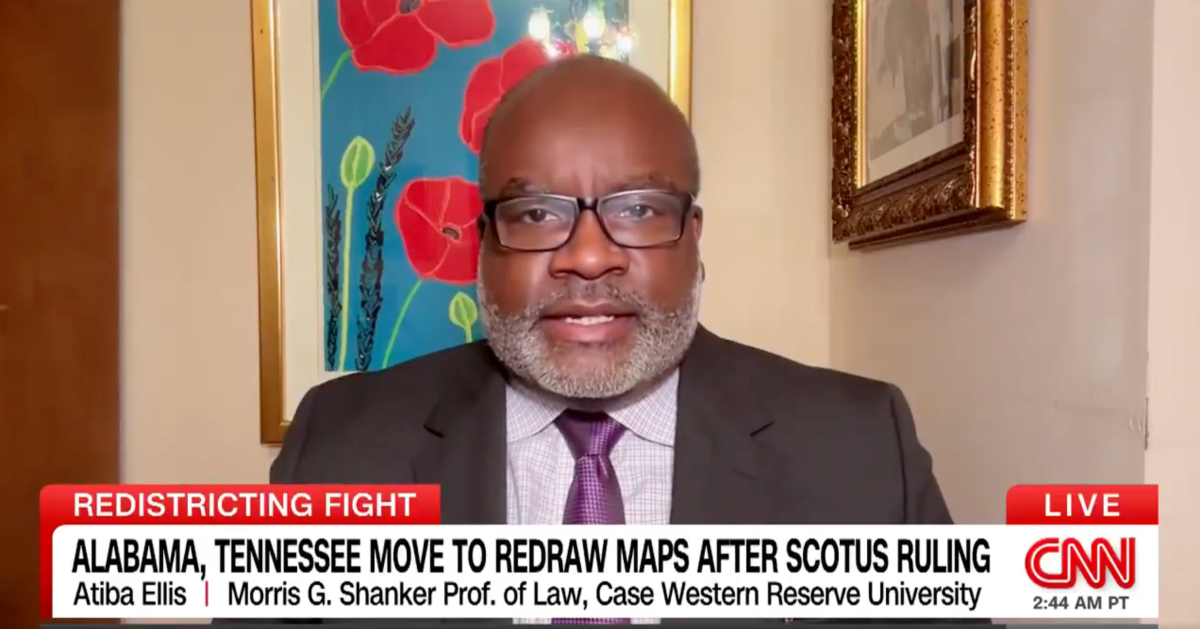
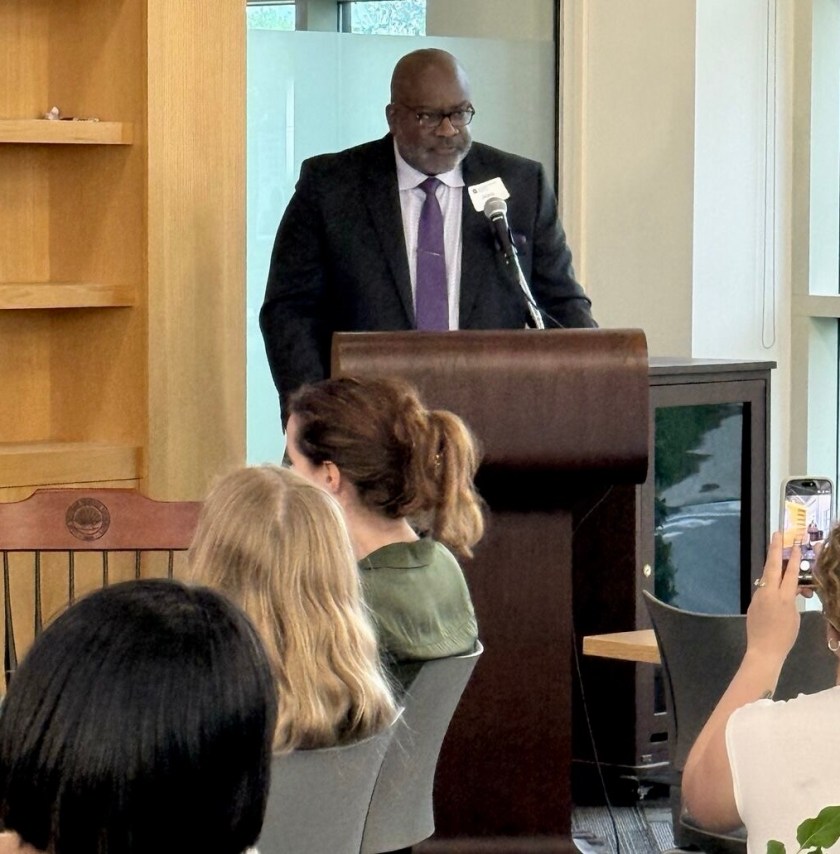
On Wednesday, May 13, 2026, I was formally recognized by the Case Western Reserve University School of Law as the Morris G. Shanker Professor of Law. In this manuscript for my investiture remarks, I offer a personal reflection on how the present moment in American democracy (especially post-Callais) fits into history and how I find hope in this most difficult of moments.
Last month, I was having lunch with a friend of decades-long acquaintance, a friend with whom I connected at my thirty-year college reunion. Early in our meal, I complained about a book chapter I was working on. I commented that I found myself frustrated. I felt sick of writing about the law of democracy over and over again.
Of course, the chapter is about voting rights and voter suppression – topics about which I’ve written at length in what is now the prelude to my twentieth year in the legal academy. I’ve tried to name voter suppression as inequality, an expression of—and a product of—disinformation, distrust, and discord around the belief that we can and should have an authentic multiracial democracy. The existence of voter suppression cuts against the vision that the voters (and We the People generally) ought to be treated as the true source of the legitimacy of our republic, since the legitimacy of government comes from “the consent of the governed.”
Those words from the Declaration of Independence make a promise, a promise that our Founders encoded (poorly) in the Constitution. And when, after two generations of struggle our republic found that this promise—such as it was—did not truly speak to the people since the Constitution perpetuated caste, our republic made this promise again in its “second founding” brought about by the Reconstruction Amendments and the laws meant to bolster it, like the Civil Rights Act of 1866 and the Klu Klux Klan Act of 1871. And when, again, that promise failed because Jim Crow made two Americas–a democracy for some, and a racial authoritarian state for others–and in the name of answering the demand of folks like Martin King’s who demanded of this country to “Give Us the Ballot,” this nation again restated its promise – through laws like the Civil Rights Act of 1964 and the Voting Rights Act of 1965.
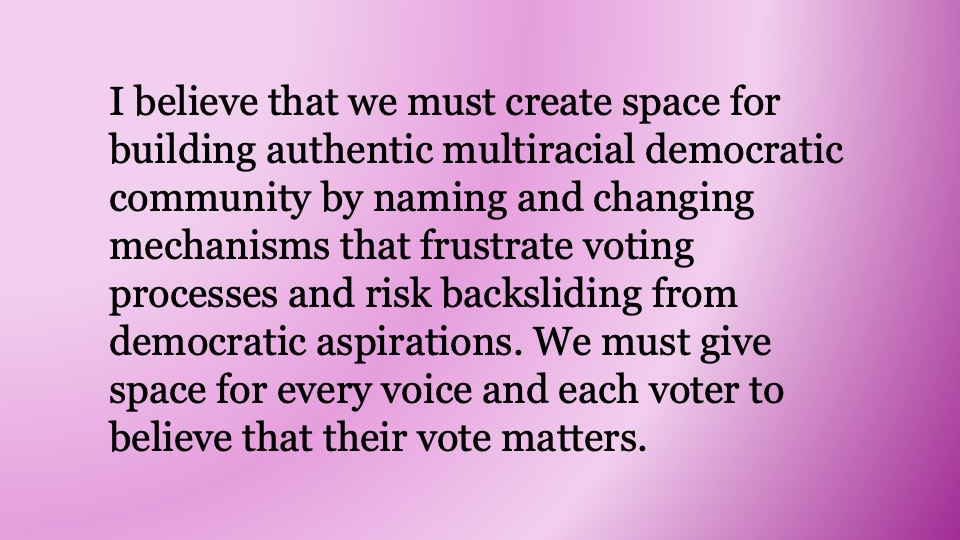
In all these places I have found the possibility and the potential that we must our heart, be a democracy and build community despite the received boundaries of race, sex, gender, nationality, ability and distrust. I believe that we must create space for building authentic multiracial democratic community by naming and changing mechanisms that frustrate voting processes and risk backsliding from democratic aspirations. We must give space for every voice and each voter to believe that their vote matters. This will serve the goal of governmental legitimacy and preserve the democratic promise.
Specifically, in my work, I’ve tried to illustrate that governmental design that presumes distrust of those who participate, and in the process, plants seeds of distrust of our fellow Americans based on over-exaggerated myth, is a danger to the republic itself. (And we’ve seen in the last decade, meme, myth, denial and insurrection have served to threaten the heart of the democratic mechanism of our republic.)
I also believe – and the need for a conversation about this more clearly present than ever – that a constructive race consciousness that traces out our personal and structural patterns of discrimination and works to correct them in the name of inclusion and authentic multiracial democracy is needed now more than ever. It is the original sin that persists from the settling of this land and the founding of this country on the back of slavery.
It is through conscious conversation and intervention to build community, rather than denial of the the reality of racism or the premature declaration of unwarranted democratic success, that the promise of democracy can be fulfilled, 60, 160 or 250 years after it was made.
Many who have come before me, and many who have and will come after—especially those who learn in the halls of Case Western Law School and carry the message to the world—have sought to evoke this democratic promise and to strive that our entire country tries to live up to it. Those like Fred D. Gray who helped shape the law in the period of the Second Reconstruction—and blazed a path that many of us seek to follow. And those of my students who have helped me write and who are now off to write their own chapter in this uniquely American story.
For the two generations of the Second Reconstruction, our laws, though not perfect, nonetheless helped to bring the promise of a multiracial democracy to reality. But with every advance comes retrenchment. Every step forward is accompanied with two, three, or more steps back. And on this day, two weeks after the Supreme Court’s decision to hollow out Section 2 of the Voting Rights Act in Louisiana v. Callais, that backsliding feels like an all-out rout. Some would say it’s just politics. Some would say that it is the reinvention of—perhaps, even the second coming of—Jim Crow. But it also feels like the moment we see in 2026 is eerily similar to the retrenchment we saw in 1903, or 1877, or 1857, or in the flaw of what was left out of ‘our’ Declaration of 1776.
Our democracy—in its cyclical efforts to be born, live free, and exist for the People—can be stuck and frustrated, just as I felt writing that book chapter. But my classmate and lunch friend unwittingly gave me a challenge. She challenged me to write (or maybe, I could say, to live) as if this frustration at the cycles of history is our truth and to write with the energy and the frustration and—dare I say—outrage that comes from living in this time.
Indeed, as I understand history, it is that frustration and outrage—and the decision to demand more by doing something about it—that is the source of hope. It is the hope of 1903 where Jackson W. Giles’s lawsuit–though unsuccessful–inspired a movement that had its high point in Lyndon Johnson’s signing of the Voting Rights Act. It is that suit by Harriott and Dred Scott to possess their own humanity–though lost–that was nonetheless a catalyst for the promise of equality embedded in the Fourteenth Amendment. And in this age of Callais, the future of multiracial democracy remains unwritten but can strive in possibility—if we are dedicated to making the possibility a reality.
My friend’s encouragement to write in that truth reveals possibility in the cycles of history. That possibility allows me—allows us—to speak for the multiracial, mindful democracy that many dreamed of before and for which we hope today. We can speak to possibility the way that Wynton Marsalis and Stanley Crouch imagined in their poem/sermon/musical masterpiece, Premature Autopsies, when the personified legacy of slavery speaks to the imagined soul of America and says, “If you give me a fair chance, I will help you better understand the meaning of democracy.” Let us continue using our history to evoke a future where we can understand—and for our posterity create—the meaning of democracy.


