Thoughts on July, Reconstruction, and a New Birth of Freedom

I have a habit of memorializing July 3, 1863 — the end date of the Battle of Gettysburg. When I’m home, I will usually stream Episode Five of The Civil War by Ken Burns: The Universe of Battle. (Actually, I still own the DVD box set.) I’ve written about this habit of mine before. Indeed, I texted friends of mine “Happy July 3rd!”

I believe Gettysburg matters now more than ever because the victory there opened America to a possibility of “a new birth of freedom.” But that possibility can still be lost.

Now, I realize you’re probably reading this while celebrating Independence Day 2025. You might be thinking, isn’t “The Fourth,” which celebrates the signing of the Declaration of Independence on July 4, 1776, the holiday that matters? If July 3rd was a big deal, you might argue, it would be a holiday too. Maybe you’re lauding the fact that the Declaration pronounced that “all men are created equal.”

But that proposition, while an eloquent and seminal idea, isn’t the entire story. Thomas Jefferson, the drafter of the Declaration, wrote, then under pressure, deleted an anti-slavery passage from the Declaration. Even after the Revolution, slavery shaped the framing of the Constitution and divided the United States for decades. Indeed, Fredrick Douglass, lauded abolitionist and civil rights activist, pointed out in 1852 the meaningless of celebrating the liberty and equality proclaimed on the Fourth of July in the face of chattel slavery. All persons may have been created equal, but slavery created a caste system that divided America.

This entrenched conflict over slavery came to a head in the Civil War, and 87 after the founding, on July 1-3, 1863, the Battle of Gettysburg was fought. To quote the Smithsonian Institution’s essay celebrating the 150th anniversary of the Civil War, the Battle of Gettysburg was “the moment of decision” for the conflict.
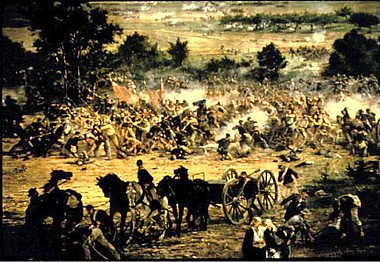
A chaotic scene depicting the Battle of Gettysburg, with soldiers, horses, and cannons amidst smoke and dust.
By Paul Philippoteaux – National Park Service website: [1], Public Domain, https://commons.wikimedia.org/w/index.php?curid=2051550

“Gettysburg changed everything,” the Smithsonian essay continues. After the defeat of the Army of Northern Virginia, “[t]he North began to see Robert E. Lee as a mortal, a flawed individual capable of being defeated. Also, coupled with General Ulysses Grant’s vanquishing of the last southern stronghold on the Mississippi—Vicksburg fell on July 4, the day after the conclusion of Gettysburg—the North believed that the Union cause had finally acquired military leaders capable of prosecuting the war.”

The possibility of new liberty through Union victory became clear in July 1863.

And with victory in April 1865 came Reconstruction, and with it the abolition of legal slavery, the redefinition of citizenship, and the creation of the foundation of the civil and political rights in America today. Yet, as quickly as these rights were articulated, these rights were betrayed through political manipulation, judicial undercutting, and open racial violence. Nearly a century of Jim Crow segregation ensued, and America needed protest from Selma to Washington to lead to a Second Reconstruction that (re-) establish the promise of formal civil and political rights for all. And even today, the terms of Reconstruction are still being debated and can be lost.

But without the conclusion of the Civil War, and the turning of the tide of that war made at Gettysburg, the United States as we know it now could never have existed. Indeed, without the victory at Gettysburg, Lincoln could not have articulated in his famous address at the dedication of the Gettysburg battlefield, a new declaration for the United States:

that this nation, under God, shall have a new birth of freedom – and that government of the people, by the people, for the people, shall not perish from the earth.

To read July 3rd along with July 4th, to see the scope of America as ranging from Independence Day to Gettysburg, from the Colfax Massacre to Selma, from the beginning to today and all the struggle in between, is to recognize that the work of Reconstruction remains incomplete.

It is to celebrate how far American has come, but to recognize how far America has to go to fulfill its promise. Propositions that we used to think of as well settled — like birthright citizenship, a universal right to vote, and a commitment to liberty and justice for all — remain contested a century and a half later.

And so long as we debate whether some have rights, and others suffer as a consequence, none of us is truly free. And the work of changing this for the better, of making us all free is, in Lincoln’s words, “the great task remaining before us.”
On Overstating the Case for Confederate Monuments

It is that values question we should really be asking. As far as I can tell, those who object to the removal of the statutes seem to be saying that those Confederate generals who defended slavery, secession, and white supremacy represent the values of a twenty-first century America that is becoming more egalitarian and diverse.

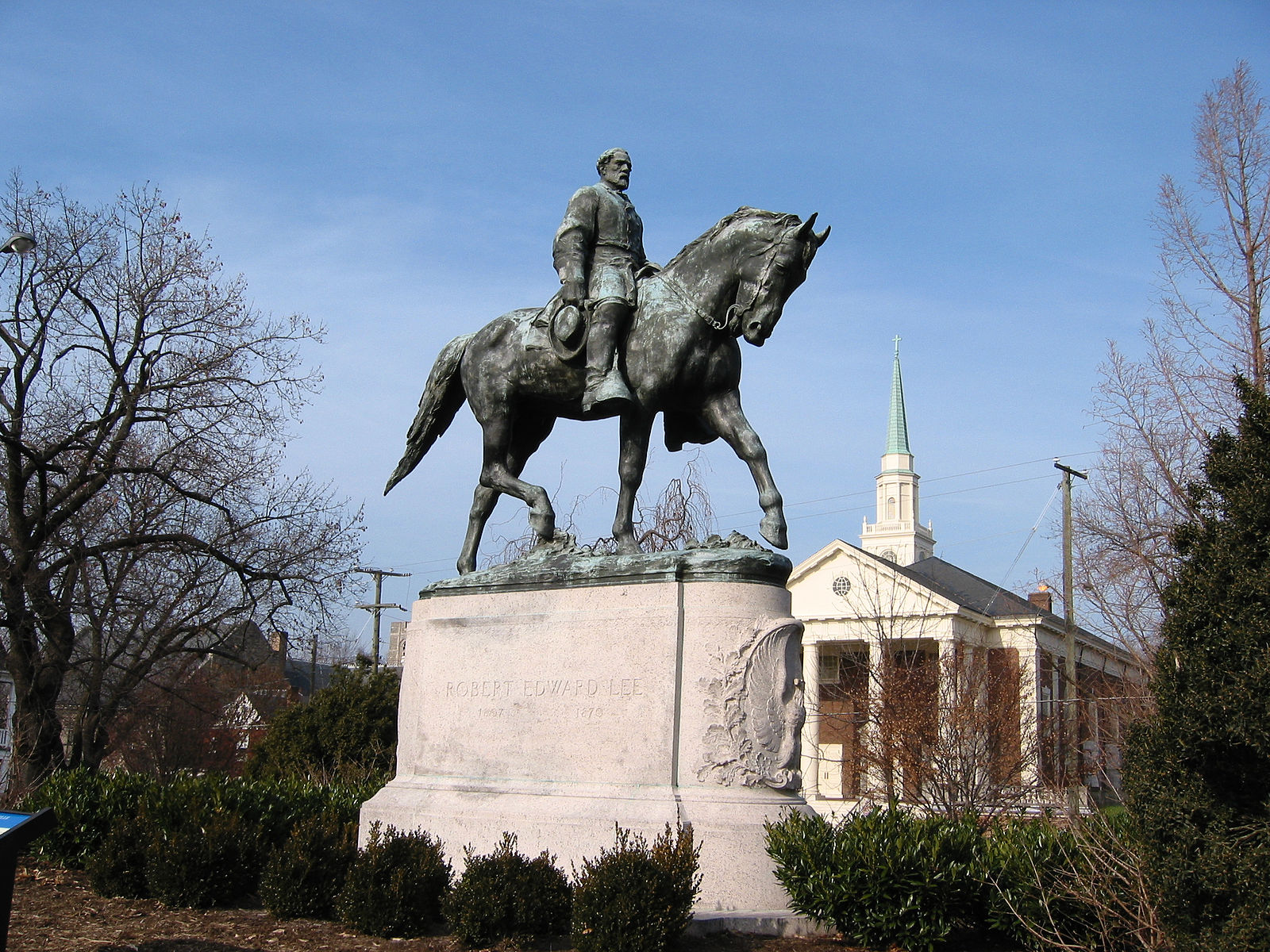
The Robert Edward Lee statue in Emancipation Park

It is overstatement to say that by removing monuments to Confederate generals one is erasing all history. Commentators have wondered aloud whether this will become a long-term movement towards total eradication of history of the South. The president even suggested this by asking when this will stop. He called the removal of Confederate monuments the destruction of culture. These claims incorrectly conflate crafting historical memory with the fact that honorific statuary in public places signals the values of the modern-day community.

Memory of the Civil War and its aftermath will not suddenly be completely erased forever because statues are torn down, street names changed, buildings renamed, and the like. Culture will not be destroyed. (And as an aside, one should ask, “Who’s culture is being protected by protecting these monuments?”) The consequences of the Civil War, for good and ill, linger. Moreover, history’s memory is a lot longer than the beginning and ending of a statue, and history will continue to be useful as long as scholars, schools, and society have open and honest conversations about the past.

History is dynamic. Honorary statues are not. Communities change and values evolve and those who are honored yesterday may be disfavored tomorrow. Think about it this way–when the American Revolution concluded, as my friend and Marquette colleague Edward Fallone points out, no one objected that the history of British rule over the colonies would be erased forever when the statues of George III were torn down. Two hundred forty one years later, we literally still sing songs to sold-out audiences about the American Revolution. And Hamilton the Musical! still gets the facts right.

The communal choice of determining who is and who is not to be honored in the present day is a completely different conversation than one about the state of history. We shouldn’t confuse the two.

Who gets honored in community space ought to be a democratic conversation for each generation. Before the revolution, George III was King. After the Revolution, George III did not represent what America means anymore to the majority of Americans, so statues to him had to go. Similarly, if the representatives of the public and private will in twenty-first century America have arrived at the decision that the twentieth century images of those who committed treason and insurrection to protect nineteenth century chattel slavery no longer deserve public places of honor because those communities see themselves as dedicated to egalitarian democratic values, then it does not follow that for some sense of static history the statues should not come down. That would privilege the ideology of the nineteenth century over the reality of the voices of the twenty-first. (And, as evidence is showing, the statues at issue now went up precisely to signal the ascendancy of white supremacy, both in the 1920s at the height of Jim Crow and 1950s in mass resistance to the racial integration demanded by Brown v. Board of Education.)

One may object that the judgments of history are cruel. The vicissitudes of the future may be such that one day, Martin Luther King, Jr. memorials and street names may be arbitrarily torn down, that today’s egalitarian heroes may end up tomorrow’s villains. The people who win this argument today and see the statues torn down, the argument goes, will end up losing the argument tomorrow. That slippery-slope reasoning misses the point. To quote Hamilton the Musical, once you and I are extinct, neither of us has control over “who tells our story.” That’s just the reality. All we can do is live our lives now in a way that makes our values clear and be content to let history be the judge of that.

It is that values question we should really be asking. As far as I can tell, those who object to the removal of the statutes seem to be saying that those Confederate generals who defended slavery, secession, and white supremacy represent the values of a twenty-first century America that is becoming more egalitarian and diverse.

As to that, all I can say is those folks have a lot of convincing to do. I think I have made clear that I’m not persuaded by this. But, in the spirit of free speech, those who support the statues get to make the argument. And short of turning the protest to violence—which they did—they even get to light their citronella tiki-torches and march in Charlottesville, Boston, and wherever else. And those of us who disagree should do so, and peacefully point out the error of their ways. (Remember: the First Amendment may protect your right to object from state sanction, but it doesn’t protect you from the consequences of disagreement.)

But as the supporters of letting the legacy of the Confederacy continue to be central to our twenty-first century places of honor make that argument, my advice is to not overstate the claim by saying the removal of the Confederate generals’ statues erases history. That argument will likely cost you a lot of your audience. And they won’t forget.